


✨ Guiding Statement
Note: There are many approaches to completing a Fourth Step inventory. I choose to follow the instructions outlined in the book Alcoholics Anonymous to the best of my understanding, and this is the method I use when mentoring others. The purpose of Step 4 is to uncover the patterns, resentments, fears, and behaviors that create turmoil in our lives—and ultimately lead us back to food abuse. This step is about facing truth with courage and compassion.
Facing Fear: The Second Part of Step 4
In the Fourth Step of recovery, we’re asked to make a searching and fearless moral inventory of ourselves. The first part focuses on resentments, but the second part turns our attention to fear—those quiet, persistent forces that shape our decisions, reactions, and sense of self.
Fear is often woven into our resentments, but it can also exist independently. This inventory sheet helps us identify and process both types. It’s not just about naming fears—it’s about understanding their roots, examining our reliance, and learning to shift our perspective through prayer and reflection.
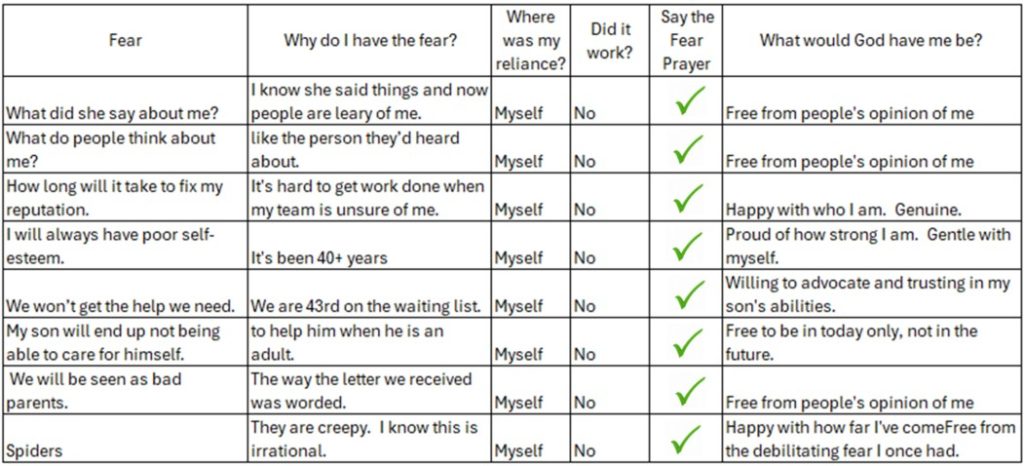
The method I use is based on the instructions in the Big Book of Alcoholics Anonymous, interpreted through years of personal experience and guidance from my sponsor, LC. While the book outlines five columns, I’ve added a sixth column that helps deepen the spiritual connection and personal insight. You’ll see this reflected in my example sheet.
🧾 The Six Columns of the Fear Inventory
Column 1: List of My Fears
I begin by copying fears from my resentment sheets—specifically from the “Frightened” section. Then I add any other fears or phobias that haven’t yet been listed. These can be irrational (like my fear of spiders) or situational (like being hit by a car or bus). The goal is to be honest and thorough.
Column 2: Why Do I Have This Fear?
Here, I briefly note the reason behind each fear. I keep these explanations short to avoid spiraling into negative thinking. This column is about identifying—not indulging—the fear.
Column 3: Where Was My Reliance?
This column asks whether I was relying on my finite self or my infinite Higher Power. In the past, I’ve written that I was relying on my Higher Power, but in hindsight, I realize that if the fear persisted, I was likely still relying on myself.
This column can reveal spiritual roadblocks. If I’ve conceded powerlessness in Step 1, then I’ve acknowledged that my personal power is limited. Turning my will over to a Higher Power means trusting in something greater—something infinite. Column 3 helps me learn what I truly have power over, and what I don’t.
Column 4: Did My Reliance Work?
If a fear appears on my inventory, that means it’s still present. And if it’s still present, then my reliance on self didn’t work. That’s not a failure—it’s just human. Many of us rely on ourselves in ways that don’t serve us. The Big Book reminds us that we don’t need to apologize for relying on a Higher Power. People of faith are often powerful, not weak.
Column 5: Say the Fear Prayer
The Big Book offers a simple but profound prayer:
“We ask Him to remove our fear and direct our attention to what He would have us be.” (p. 68)
I personalize this prayer to address each specific fear:
- Please remove my fear of spiders, and direct my attention to what You would have me be.
- Please remove my fear of what Lena has said about me, and direct my attention to what You would have me be.
You can also turn this into a statement if that feels more natural. In fact, please do change it to make sense and into something you actually believe in.
Here are some ideas:
- I’m choosing not to let fear run things, and I’m focusing on being my best self.
- I’m dropping the fear and putting my energy into acting according to my values.
Column 6: What Would My Higher Power Have Me Be?
This final column isn’t found in the Big Book, but it’s a powerful addition. LC taught me to use it to connect with the deeper meaning of the prayer. The forms from oabigbook.info include this column, and I encourage you to try it.
At first, I struggled with this exercise. I kept writing things like “say my prayers” or “speak up”—actions rather than states of being. LC helped me see the difference. This column is about being, not doing.
Another AA member pointed me to a passage in The Family Afterward:
“We are sure God wants us to be happy, joyous and free.” (p. 133)
A mentor once explained the difference between happy and joyous:
- Happiness is based on external circumstances (like finding a good parking spot).
- Joy is internal and unaffected by what’s happening around me.
When I fill out this column, I aim for statements like:
- Spiders: Happy they eat other bugs. Joyous that I have courage to face them. Free from the debilitating fear I once had.
- Lena: Happy my coworkers are getting to know me better. Joyous that I am a person of integrity. Free from the belief that everyone must like me.
I don’t always use “happy, joyous, and free,” but I make sure my statements reflect qualities like honesty, love, and firmness. This column doesn’t instantly erase fear, but it gives me a new lens—a way to shift my focus from fear to faith.
🌱 Final Thoughts
Fear is a powerful force, but it doesn’t have to define us. This inventory helps me name my fears, understand their roots, and begin the process of spiritual transformation. It’s not about perfection—it’s about progress. The deeper the fear, the more intentional I must be in shifting my mindset toward what my higher power would have me be.
I’ve filled out my example in the image below. In my next post, I’ll explore how these insights continue to unfold in daily life—and how fear, when faced with honesty and faith, begins to lose its grip.
Let’s keep walking this path together.
Leave Comment